Thursday, July 6, 2017

Saturday, February 28, 2015
TROY VAN LEEUWEN AND THE FENDER DOUBLE-NECK JAZZMASTER
If you’ve been to a Queens of the Stone Age concert recently, you likely saw a monster of rock on stage at some point during the show.
But we’re not talking about the intimidating 6-foot-4 QOTSA frontman Josh Homme.

Van Leeuwen (L) and Paul Waller discuss the double-neck Jazzmaster project at the Fender Custom Shop.
In this case, the unmistakable monolith is actually guitarist Troy Van Leeuwen’s new Fender Custom Shop double-neck Jazzmaster, a 12- and 6-string beauty.
Guitars with two necks are not as rare as one would think, but the fact that Van Leeuwen’s was made with the body style of the offset Jazzmaster pointed this mission into uncharted waters.
Wednesday, November 12, 2014
Dave Grohl ES-335

In his successful segue from drummer with legendary Nirvana to guitarist, singer and songwriter with Foo Fighters, Dave Grohl has eternally secured his reputation as one of the most influential alternative rockers of our time. Dave’s choice of electric guitar—surprising to some, a traditionally inspired semi-acoustic—further emphasizes his individuality, and declares his dedication to tone, style, and classic Gibson quality. To celebrate Dave’s achievements, Gibson Memphis introduces the Dave Grohl ES-335, a guitar made in the tradition of the great thinline vintage semi-acoustics, with Dave’s signature apparent from every angle in its distinctive looks, sound and feel.
Read More Here
Wednesday, November 5, 2014
4 SIGNATURES MODELS FOR FOO FIGHTERS
For an artist, it must be quite an honor to have your own Fender or Gibson signature guitar model. Most of the great guitar gods have had signature models created for them. JoePass, Tal Farlow, The Everly Brothers, Johnny Smith, Les Paul, Chet Atkins, The Ventures and Trini Lopez were among the first. In the 70’s and 80’s, it was George Benson, Paul Stanley and Bob Weir models by Ibanez. In the 90’s, there were Eddie Van Halen models, along with a flock of other metal notables. The turn of the century brought a signature model for super players Eric Clapton, Pete Townshend and Jimmy Page. Even some greats no longer with us like Jimi Hendrix, Paul Kossof and Randy Rhodes received the honor of having their own signature models. One band with the unique distinction of having 4 signature models created for them is still very much alive and rocking. In fact, in 2013 they’re still packing arenas and recording relevant music. That band is the Foo Fighters.

GIBSON: Honoring Grohl
The Foo Fighters have had four meaningful signature models developed in the past few years. First and foremost was a limited edition no longer available called the “inspired by Dave Grohl” Gibson DG-335. In 2007, another classic was released. This one, created by the the artisans of the Gibson Custom Shop, was actually a re-release of the Vintage Gibson Guitar, the“Trini Lopez” signature model that was popular from 1964-71. Grohl has always been a fan of the Trini Lopez model, which is a hybrid between a solid body and a hollow body. The limited model was produced in a rare Pelham Blue color.The DG-335 has the same classic Firebird-style headstock with six-on-a-side tuners. The body has stylish diamond f-holes. The inlays on the fretboard are acrylic split diamond. This unique feature was inspired by the original Trini Lopez model. The pickups are original Patent Applied for humbuckers, designed to deliver the amazing tones that Grohl has become famous for with the Foo Fighters.

TELECASTER: Chris Shiflett’s Signature
Grohl is not the only Foo Fighter with a signature edition, Fender has recently released the Chris Shiflett Signature Telecaster Deluxe and the Nate Mendel P Bass. The Tele is based on Shiflett’s favorite vintage fender guitar, his 1972 Fender Telecaster Deluxe. It has an Arctic White Finish, a four-ply white pearl pickguard, two custom designed humbucker pickups, a custom stenciled case and Shiflett’s signature on the headstock.The original Telecaster Deluxe was produced by Fender from 1972. It was designed to produce the thick sound of late 1960’s heavy rock created by humbucker pickups. To do this right, Fender hired Seth Lover in 1967. Formerly from Gibson. Seth was the inventor of the humbucker pickup. Lover created the Fender “WideRange” humbucker, which was featured on the Telecaster Deluxe, Custom and Thinline Models.
.jpg)
FENDER: Nate Mendel’s Model
The Fender Nate Mendel Signature Bass is modeled after his 1971 Fender Precision Bass. It features a slightly road-worn candy apple finish, an extra slim neck, a Seymour Duncan Quarter Pounder Split Coil Pickup, a Leo Quan Badass II bridge and an extra neck plate with a hybrid “Fender/Foo Fighters” logo. Mendel has expressed his affection for his 71 P-Bass and the features that make it unique and Fender has gone to great lengths to duplicate the specifics.
HAGSTROM: Pat Smear’s Namesake
Long time touring guitarist, Pat Smear, formerly of The Germs and Nirvana, has a signature model built for him by Hagstrom. The Pat Smear signature model is a double cutaway mahogany body, set neck, capped with a maple top. Each guitar is said to be built by the same standards as Pat’s guitars. The design is a custom hybrid of a 1970’s Hagstrom model “H-IIN-OT” and the modern day “F-200.”Saturday, October 4, 2014
The Gibson Firebird
What does a car designer know about designing electric guitars? Collectors of vintage gibson guitars already know the answer. Plenty. In the 1960’s, Gibson put that fact to good use.
Gibson electric guitars had made a name for themselves in the 50’s with the Telecaster, Stratocaster,
 and the Les Paul. And one might have assumed that they would ride the crest of their success for a long time to come. But during the 50’s, the popularity of Gibson electric guitars started to decline. And by the 60’s, Gibson electric guitars had a reputation of being higher priced and less innovative than Fender’s electric guitars. The colors, shapes and multiple pickups characteristic of Fender’s main stream electric guitars were favored by well-known guitarists of the time. Clearly, Gibson electric guitars were in need of a competitive edge. And car designer Ray Deitrich was hired by Gibson president, Ted McCarty, to do just that.
So again, the question, “What does a car designer know about designing electric guitars?” Actually, car designs of the times offered a wealth of inspiration. The sleek lines of the car tailfins of the 50’s inspired the now revered, “Firebird”.
Known as “reverse” electric guitars, the original Firebirds were designed “backwards” with the right-hand treble horn of the body longer than the other. However, the unusual reverse-body design unique to Gibson electric guitars was not a marketing success. And in 1965-1969, Gibson introduced “non-reverse” models.
So what was it that made the Firebird so instrumental in Gibson’s return to favor?

The Firebird had a number of unique features that made it a stand-out. For starters, it was the first of the solid-body Gibson electric guitars to use neck-through construction. Those who know vintage guitars know that the Firebird’s neck extended to the base of the body. Five ply mahogany reinforced by four narrow strips of walnut gave the neck added strength. “Banjo” tuning keys, reverse headstock and mini-humbucking pickups enhanced the early Firebirds. Some models from ’65 featured the single-coil P-90 pickup.
The Firebird line was introduced to the market in mid 1963. Four models – each unique in pickup and tailpiece configurations went on sale. While the Les Paul line had distinguished its models as “Junior, Special, Standard and Custom”, the Firebird Series used roman numerals “I, III, V and VII” . Interestingly, during Gibson’s efforts to reclaim some of the market it had lost to Fender – Fender actually threatened to bring a lawsuit against Gibson with claims that the Firebird headstock copied that of the Stratocaster, and that the body violated Fender’s design patents. No suit followed, but disappointing sales led Gibson to drop the “non reverse” models, and in 1972, to reissue their original “Reverse” body design.
Collectors of vintage guitars and fans of Gibson electric guitars appreciate the fact that a long list of notable players have chosen the Gibson Firebird. Eric Clapton has extensively used a Firebird I. Brian Jones of the Rolling Stones used both reverse and non-reverse Firebirds. And Aerosmith’s, Joe Perry, has used many Gibson electric guitars through the years, including Firebirds.
Through the years of both Reverse, or Non-Reverse designs, the Firebird continued to impress. Today, whether it’s a I, III, V or VII, the Gibson Firebird is still flying high in popularity with collectors of vintage guitars
Gibson electric guitars had made a name for themselves in the 50’s with the Telecaster, Stratocaster,
So again, the question, “What does a car designer know about designing electric guitars?” Actually, car designs of the times offered a wealth of inspiration. The sleek lines of the car tailfins of the 50’s inspired the now revered, “Firebird”.
Known as “reverse” electric guitars, the original Firebirds were designed “backwards” with the right-hand treble horn of the body longer than the other. However, the unusual reverse-body design unique to Gibson electric guitars was not a marketing success. And in 1965-1969, Gibson introduced “non-reverse” models.
So what was it that made the Firebird so instrumental in Gibson’s return to favor?
The Firebird had a number of unique features that made it a stand-out. For starters, it was the first of the solid-body Gibson electric guitars to use neck-through construction. Those who know vintage guitars know that the Firebird’s neck extended to the base of the body. Five ply mahogany reinforced by four narrow strips of walnut gave the neck added strength. “Banjo” tuning keys, reverse headstock and mini-humbucking pickups enhanced the early Firebirds. Some models from ’65 featured the single-coil P-90 pickup.
The Firebird line was introduced to the market in mid 1963. Four models – each unique in pickup and tailpiece configurations went on sale. While the Les Paul line had distinguished its models as “Junior, Special, Standard and Custom”, the Firebird Series used roman numerals “I, III, V and VII” . Interestingly, during Gibson’s efforts to reclaim some of the market it had lost to Fender – Fender actually threatened to bring a lawsuit against Gibson with claims that the Firebird headstock copied that of the Stratocaster, and that the body violated Fender’s design patents. No suit followed, but disappointing sales led Gibson to drop the “non reverse” models, and in 1972, to reissue their original “Reverse” body design.
Collectors of vintage guitars and fans of Gibson electric guitars appreciate the fact that a long list of notable players have chosen the Gibson Firebird. Eric Clapton has extensively used a Firebird I. Brian Jones of the Rolling Stones used both reverse and non-reverse Firebirds. And Aerosmith’s, Joe Perry, has used many Gibson electric guitars through the years, including Firebirds.
Through the years of both Reverse, or Non-Reverse designs, the Firebird continued to impress. Today, whether it’s a I, III, V or VII, the Gibson Firebird is still flying high in popularity with collectors of vintage guitars
Thursday, April 24, 2014
Gibson Billie Joe Armstrong ES-137 Hollowbody Electric Guitar Black Cherry Burst
Gibson Billie Joe Armstrong ES-137 Hollowbody Electric Guitar Black Cherry Burst

New from Gibson Memphis
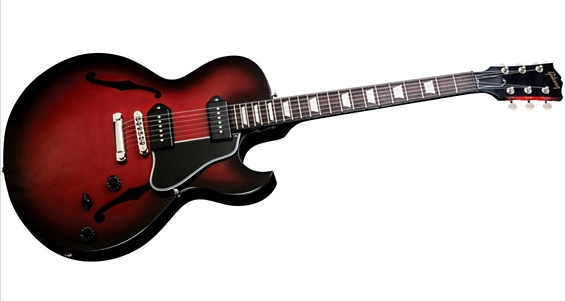
New from Gibson Memphis
Slammin' tone and uncompromising attitude just like Billy Joe himself.
As the premiere punk rocker of his generation, Green Day's Billy Joe Armstrong doesn't compromise on style, tone or attitude. The Billy Joe Armstrong ES-137 from Gibson Memphis rolls all three into a raging ball of badass, in a guitar that stems from surprising depths of tradition‒while packing the no-frills, sucker-punch power that punk demands.
This beautifully light and comfortable to play thinline semi-hollow sports the ES-175s classic lines, but thanks to a chambered mahogany core that enhances sustain and fights unwanted feedback, it rings like a bell when you hit it. And when you want it to wail, just crank the two fat and gnarly P-90 pickups‒long Billy Joe's favorites.
Grab the neck crafted to Billy Joe's preferred proportions, dial in the simplified controls to taste, and you're primed to deliver thick, meaty gobs of house-rockin' mayhem‒while looking utterly righteous in a sweet Black Cherry Burst nitrocellulose finish with traditional trapezoid inlays on a rosewood fretboard.
Includes Gibson Memphis Hard Case.
This beautifully light and comfortable to play thinline semi-hollow sports the ES-175s classic lines, but thanks to a chambered mahogany core that enhances sustain and fights unwanted feedback, it rings like a bell when you hit it. And when you want it to wail, just crank the two fat and gnarly P-90 pickups‒long Billy Joe's favorites.
Grab the neck crafted to Billy Joe's preferred proportions, dial in the simplified controls to taste, and you're primed to deliver thick, meaty gobs of house-rockin' mayhem‒while looking utterly righteous in a sweet Black Cherry Burst nitrocellulose finish with traditional trapezoid inlays on a rosewood fretboard.
Includes Gibson Memphis Hard Case.
Features
Sunday, March 30, 2014
John Paul Jones: “What Is And What Should Never Be” Isolated Bass Track
If you’re looking for vintage tone and a melodic groove, look no further.
 Zach McFatridge shared this clip of John Paul Jones’s isolated bass from the Led Zeppelin classic “What Is And What Should Never Be” from their second album.
Sunday, November 3, 2013
The Fender Jazzmaster Adapts to Everything but Jazz
Leo Fender hit it out of the park in the early 1950s with three innovative solid body instruments that changed music as we know it. They were the Fender Telecaster, Stratocaster and the Precision Bass.
But in 1957, Leo Fender set out to make another big splash. He decided to build a top-of-the-line sibling to the still new Fender Stratocaster. This one would be something completely different than anything ever created. “The Jazzmaster” was intended to be a solid-body alternative to pricey hollow body arch top guitars that were then the industry standard. But despite its big unveiling at the 1958 NAMM show, it never caught on with jazz players at the time. Today, 55 years after its release, the Jazzmaster has proven to have the ability to adapt to all types of music.
But in 1957, Leo Fender set out to make another big splash. He decided to build a top-of-the-line sibling to the still new Fender Stratocaster. This one would be something completely different than anything ever created. “The Jazzmaster” was intended to be a solid-body alternative to pricey hollow body arch top guitars that were then the industry standard. But despite its big unveiling at the 1958 NAMM show, it never caught on with jazz players at the time. Today, 55 years after its release, the Jazzmaster has proven to have the ability to adapt to all types of music.
New Design, New Tones
The body of the Jazzmaster is much larger than the Strat or Tele models. The “offset-waist” was created for playing while seated, as jazz players often do. A completely new floating tremolo system with a tremolo lock contributed to the guitar’s design. The guitar was heavily shielded to eliminate hum from its wide “soapbar” single coil pickups. These coils had magnet pole pieces and flat wound coils that gave the Jazzmaster a warm tone while maintaining single coil clarity. The tailed bridge provided picking behind the bridge for bell tones. The maple finger boards of early Telecasters and Stratocasters were already showing wear and pitting through to the wood. Gibson had demonstrated a long time commitment to Rosewood fingerboards, so Leo Fender followed suit with the Jazzmaster. Standard on Jazzmasters was the rosewood “slab board” fingerboard.

Surfing to Success
The California-based surf music and instrumental rock craze of the late 1950’s and 1960’s gave the Jazzmaster its first real stage. When Don Wilson of the Ventures played a Jazzmaster, it immediately gained an identity as a surf guitar. Kids with limited music ability, who hoped a Fender could gift them with skills, were attracted to the Jazzmaster. At the height of its popularity, Fender’s headquarters were inSouthern California. Leo Fender himself, was said to been influenced by surf players. His follow up to the Jazzmaster, the Fender Jaguar, was targeted as surf music from the start.
A Dramatic Comeback
Despite being discontinued in 1980, the Jazzmaster’s popularity wouldn’t go away. One reason was Elvis Costello. In the late 70’s, Costello arrived from the UK with a unique image and a Fender Jazzmaster always in-hand. The guitar which had fallen out of fashion came roaring back to life thanks to Costello and Tom Verlaine of the 70’s New York Punk Godfathers, “Television.” Fender created an Elvis Costello Jazzmaster in 2008 which was a replica of the singer’s most famous vintage fender jazzmaster.
Despite being discontinued in 1980, the Jazzmaster’s popularity wouldn’t go away. One reason was Elvis Costello. In the late 70’s, Costello arrived from the UK with a unique image and a Fender Jazzmaster always in-hand. The guitar which had fallen out of fashion came roaring back to life thanks to Costello and Tom Verlaine of the 70’s New York Punk Godfathers, “Television.” Fender created an Elvis Costello Jazzmaster in 2008 which was a replica of the singer’s most famous vintage fender jazzmaster.
Going Grunge
Grunge music and alternative rock provided a musical renaissance in the early 90’s, and the Jazzmaster found its place again. Sonic Youth, who began in New York in the 1980’s, had major label success in the 1990’s. The band showcased double endorsers of Jazzmasters, Thurston Moore and Lee Renaldo. These two took art rock to another level, and earned a new appreciation for the Jazzmaster. Fender later created signature versions for each of them. Both models were highly customized — from pickups to colors to knob/switch variations. Other 90’s endorsers of the Jazzmaster include major label alternative music superstars, J Mascis of Dinosaur Jr., Indie rock hero, Stephen Malkmus of Pavement, and Nels Cline of Wilco. Although his first choices were the Mustang and the Jaguar, Grunge God Kurt Cobain had a Jazzmaster in his surf-guitar arsenal.
Grunge music and alternative rock provided a musical renaissance in the early 90’s, and the Jazzmaster found its place again. Sonic Youth, who began in New York in the 1980’s, had major label success in the 1990’s. The band showcased double endorsers of Jazzmasters, Thurston Moore and Lee Renaldo. These two took art rock to another level, and earned a new appreciation for the Jazzmaster. Fender later created signature versions for each of them. Both models were highly customized — from pickups to colors to knob/switch variations. Other 90’s endorsers of the Jazzmaster include major label alternative music superstars, J Mascis of Dinosaur Jr., Indie rock hero, Stephen Malkmus of Pavement, and Nels Cline of Wilco. Although his first choices were the Mustang and the Jaguar, Grunge God Kurt Cobain had a Jazzmaster in his surf-guitar arsenal.
Here to Stay
The 1990’s created a new demand for the return of the Jazzmaster, and Fender slowly began to reissue the guitar.
It was first reissued in Japan, followed by the US and Mexico, where many variations of the Jazzmaster are currently made. And the Jazzmaster craze continues today. In 2013 Fender Jazzmasters are more popular than ever, with Fender currently producing 10 variations of the now iconic guitar.
The 1990’s created a new demand for the return of the Jazzmaster, and Fender slowly began to reissue the guitar.
 |
| Squier Baritone Jazzmaster |
Friday, October 18, 2013
The Coronado: The Un-Fender-Like Fender

The Fender Coronado
is considered quite a departure from previous Fender instruments and stands out
to vintage guitar enthusiasts as a peculiar point in Fender history. Introduced
in 1965, the Coronado was a double-cutaway, thin-line, hollow-body electric
guitar designed by Roger Rossmeisl, who also designed at the time for
Rickenbacker. So why the departure from Fender’s traditional designs?
The Coronado was Fender’s
attempt to jump on the semi-acoustic bandwagon and capitalize on the
semi-acoustic’s growing popularity.
Between 1966 and 1972, three
versions of the Coronado were produced. The Fender Coronado I, discontinued in
1970, was the original single pickup design. The Coronado II added a bridge
pickup with relative tone and volume controls. In 1967, the XII model – a
12-string version – was released.
It was a true hollow-bodied
electric. Like the Gibson ES-330 and the Epiphone Casino, the Coronado didn’t
have a central solid wood block in the body. The Gibson ES-335 looked very
similar to the Coronado, but was actually quite different in that it had a
solid central block running lengthways through the body with two hollow “wings”
attached to either side.
Vintage guitar collectors
appreciate the fact that a number of Coronado II and XII guitars were offered
with a unique “Wildwood” finish. This involved using a specially prepared,
heavily grained beechwood. A chemical dye was injected into the growing trees
prior to harvesting which stained the grain pattern of the wood.
What also made the Coronado so
“un-Fender like” were its pickups — made by DeArmond, a company that made
pickups for Gretsch. The bridge was also unusual – a free-floating,
non-anchored ‘tune-o-matic’ style bridge with a suspended tailpiece.
And vintage fender guitar collectors
would no doubt recognize the unique Coronado cases made in USA by the Vitoria
Luggage Co.
So now you know what made them
unique. Who made them famous? For starters, there’s Elvis. Remember Elvis
Presley in the 1968 film, “Speedway”? Are you old enough? If so, you may
remember his song “There Ain’t Nothing Like a Song” with Nancy Sinatra. The
Coronado was the only guitar used by The King throughout the entire film and
put the un-Fender-like Fender in the spotlight. Other notable users include
Dave Davies of the Kinks, Wayne Newton, Jimmie Vaughn, Josh Klinghoffer of Red
Hot Chili Peppers and so many more.
What do players and collectors
look for these day? All of the Coronado models are very desirable — the
Coronado I and II, the Coronado II Wildwood, Coronado XII, Bass I or Bass II
would all be respectable additions to a collection. Even though the
Fender Coronado didn’t enjoy much commercial success back then due to feedback
at high volumes, today this vintage guitar has gained a significant following
after release for its natural resonance and bright deep tone.
Fender has re-introduced the Coronado in 2013! See the Video below!
Fender has re-introduced the Coronado in 2013! See the Video below!
Tuesday, September 24, 2013
The Fender Jaguar
One of the most unique all time Fender Vintage Guitars is the Fender Jaguar. Some of its design roots can be attributed to the Fender Jazzmaster, but the Jaguar is a matchless instrument. It was released in the ‘60s as Fender’s top-of-the-line guitar. With a 24” maple neck and an aggressive-looking body, the Jaguar is one of Fender’s most stylish guitars to date.

Along with being stylish, this vintage guitar has some features that give it a unique sound, like its single-coil pickups. Like the Jazzmaster, the Jaguar features a floating tremolo arm system. Leo Fender designed this to be different from “synchronized tremolo” system of the Stratocaster. During tremolo use, the Jaguar’s bridge moves along with the strings. This conserves proper intonation and prevents the strings from binding. The
Fender originally released the Jaguar in 1962. It was popular among surf guitarists throughout the ‘60s. Its ad campaign featured people on beaches in order to make it more appealing to the surf genre. One ad from 1965 shows a man actually riding a surf board while holding a Jaguar. The ad is captioned “You won’t part with yours either.” One ad also featured Carl Wilson of The Beach Boys. Despite this vigorous ad campaign, the guitar didn't do as well as its competitors in its early years, and was discontinued in 1975.

The vintage Jaguar’s popularity started to rise again in the late ‘70s and ‘80s. Tom Verlaine of Television is shown playing one on a 1978. The guitar’s unique sound and lack of mainstream popularity made it big among punk and indie rock artists. In the 1990s, the Jaguar became extremely popular again after being used by artists like Black Francis of The Pixies, John Frusciante of the Red Hot Chili Peppers, and Kurt Cobain of Nirvana.
Fender reissued the Jaguar in 1999 as part of its American Vintage Series. The reissue was an exact replica of the 1962 Jaguar. Since then, variations of the Jaguar have also been released, most of which have humbucker pickups, like the Fender Blacktop and the Jaguar HH. Fender also issued the Jaguar Bass, the Johnny Marr Signature Jaguar, and last year, the Kurt Cobain Signature Jaguar. Since the reissue, this vintage guitar has had a major comeback.

Along with being stylish, this vintage guitar has some features that give it a unique sound, like its single-coil pickups. Like the Jazzmaster, the Jaguar features a floating tremolo arm system. Leo Fender designed this to be different from “synchronized tremolo” system of the Stratocaster. During tremolo use, the Jaguar’s bridge moves along with the strings. This conserves proper intonation and prevents the strings from binding. The
Fender originally released the Jaguar in 1962. It was popular among surf guitarists throughout the ‘60s. Its ad campaign featured people on beaches in order to make it more appealing to the surf genre. One ad from 1965 shows a man actually riding a surf board while holding a Jaguar. The ad is captioned “You won’t part with yours either.” One ad also featured Carl Wilson of The Beach Boys. Despite this vigorous ad campaign, the guitar didn't do as well as its competitors in its early years, and was discontinued in 1975.

The vintage Jaguar’s popularity started to rise again in the late ‘70s and ‘80s. Tom Verlaine of Television is shown playing one on a 1978. The guitar’s unique sound and lack of mainstream popularity made it big among punk and indie rock artists. In the 1990s, the Jaguar became extremely popular again after being used by artists like Black Francis of The Pixies, John Frusciante of the Red Hot Chili Peppers, and Kurt Cobain of Nirvana.
Fender reissued the Jaguar in 1999 as part of its American Vintage Series. The reissue was an exact replica of the 1962 Jaguar. Since then, variations of the Jaguar have also been released, most of which have humbucker pickups, like the Fender Blacktop and the Jaguar HH. Fender also issued the Jaguar Bass, the Johnny Marr Signature Jaguar, and last year, the Kurt Cobain Signature Jaguar. Since the reissue, this vintage guitar has had a major comeback.
The Gibson S-1
In the 1970s the major American guitar companies were losing money due to sales of the competition, whose sales model was to produce quality instruments at drastically lower production costs. Gibson Guitars has proven over the years that they were always willing to change their approach to guitar creation from decade to decade. This is clearly illustrated throughout their history from the 1950s creation of the Flying V and Explorer, to the GibsonFirebird / Thunderbird line of the 1960s, to some interesting instruments in the 1970s that were created with factors new to Gibson such as bolt on necks and newer woods such as maple and alder.

One of these instruments was the 1975 Gibson S-1, which was an effort to create a single coil-pickup guitar that could sound like a Fender at times while also keeping the ability to create a humbucker Gibson sound by combining coils with a “chicken head” four position rotary switch. The Gibson S-1 was shaped like a Gibson Les Paul with a Gibson Flying V peg head.
The Gibson S-1 is often mistaken for the Gibson Marauder, which had on humbucker and one slanted single coil pick up. While the Gibson S-1 was endorsed by Ron Wood, the Marauder was endorsed by Paul Stanley of Kiss. Either one is an easy way to get in the door of Collecting Vintage Guitars, find one at a vintage guitar shop at around $800-$1000.

One of these instruments was the 1975 Gibson S-1, which was an effort to create a single coil-pickup guitar that could sound like a Fender at times while also keeping the ability to create a humbucker Gibson sound by combining coils with a “chicken head” four position rotary switch. The Gibson S-1 was shaped like a Gibson Les Paul with a Gibson Flying V peg head.
The Gibson S-1 is often mistaken for the Gibson Marauder, which had on humbucker and one slanted single coil pick up. While the Gibson S-1 was endorsed by Ron Wood, the Marauder was endorsed by Paul Stanley of Kiss. Either one is an easy way to get in the door of Collecting Vintage Guitars, find one at a vintage guitar shop at around $800-$1000.
Monday, September 16, 2013
Famous Guitarists Caught Playing Guitars Other than their Usual Part 002

Sunday, September 15, 2013
Famous Guitarists Caught Playing Guitars Other than their Usual Part 001

Warren Haynes has long been a supporter of Vintage Gibson Guitars, favoring 1958 Les Paul’s, Dot Neck ES-335s and Non-Reverse Firebirds with p-90s when he is seeking single-coil punch. Halloween 2008 in Boston forced Haynes to put down his Gibson favorites and pick up another model, in order to play an entire set of Pink Floyd tunes, Haynes had no choice but to recreate it the way it was originally played — on a Vintage Fender Stratocaster.
Thursday, August 8, 2013
GUITARS & CLIMATE CHANGE
Our shop, recently, received several (many) acoustic guitars
with changed action and neck misalignment(s) even though owners made efforts to
ensure their guitar is in a controlled climate, or in a case, or breathing open
air (A/C) kept in house. Despite owner care and handling these guitars changed.
Some guitars we received had high action, under set necks,
and dehydrated bodies while other guitars had signs of over set necks, fret
buzz, and bloated bodies. These are symptoms of: CLIMATE CHANGE to a guitar.
Procedural, when a neck is under set with high string
action the remedy is a neck reset followed by a full fret dressing. Conversely,
the same procedure is the remedy for an overset neck.
We've changed our analysis when now we see these conditions.
That is, prior to looking at mechanical dysfunctions we are now examining a
guitar's hydration to see whether an instrument is over-hydrated or
under-hydrated.
Read More Here: http://bit.ly/1cODQqW
For Information on Climate Control Please See HVAC Company MA
Wednesday, August 7, 2013
Top Ten Classic Rock Guitars
Stevie Ray Vaughn’s Fender SRV Stratocaster
10. Stevie Ray Vaughn’s Fender SRV Stratocaster


The Stevie Ray Vaughn Stratocaster signature model was based
on Vaughn’s favorite guitar, “Number One”, also called his “First Wife”. The
SRV Stratocaster was in the works in the late ‘80’s with a planned release date
in 1989. Stevie’s touring and recording schedule, however, delayed its release.
Finally, in 1990, Stevie was presented with 3 prototypes, right before his
Tonight Show performance. That night, his notable SRV stickers on the pickguard
were missing, so the Tonight Show art staff got creative and applied temporary
white Letraset stickers. Vaughn liked the script-style lettering so much that
he suggested that the lettering be engraved into the pickguard – as it appears
today. Vaughn died about 10 weeks after his Tonight Show appearance, and the SRV
was put on hold until 1991. At that time, at the direction of Stevie’s brother
Jimmi, plans for the Limited Edition were scrapped. Jimmi’s goal became making
sure the SRV guitar was affordable so that “every kid that wanted one could
afford one.”
9. Jerry Garcia’s Tiger

Where did Garcia’s rich, deep tones come from? From his
appropriately named “Tiger”. Jerry’s custom-made guitar was named Tiger because
of the inlay on the battery/preamp compartment. Tiger was built in the
so-called Alembic “Hippie Sandwich” tradition described as several different
layers of wood sandwiched together to create beautiful layers. Tiger’s top
layer was cocobolo, followed by a stripe of Maple, then a layer of Vermillion
and a Flame Maple core. The binding across the body and front of the guitar is
brass, with a gorgeous inlay on the back side of the body. The neck, made of
Western Maple, has a hardwood section of padauk inlayed in the back. The ebony
fret-board is enhanced with a brass binding. One writer states that Tiger is
“12 ½ pounds of muscle and beauty” — the power behind the sound that defined
the Grateful Dead.
8. Bob Dylan’s 1964 Sunburst Fender Stratocaster

When Bob Dylan plugged in his 1964 Sunburst Fender Stratocaster
at the Newport Folk Festival, he literally electrified rock history. But there
was controversy surrounding his first live “plug-in”. Dylan was booed by his
fans. The reason for the crowd’s hostile reaction was either that Dylan
appeared to be “abandoning” the folk orthodoxy, or poor sound quality on the
night of his performance – or a combination of the two. Either way, Dylan’s
actions had huge implications for both rock and folk music. His ’64 Sunburst
Fender Stratocaster was front and center in the event that shifted Dylan’s
career.
But the famous guitar has stayed in the limelight. Dylan’s
history-making Strat went missing for 47 years, and controversy over its
whereabouts still simmers. In a Rolling Stone Music article, PBS Detectives are
quoted as saying that the missing guitar has been found in the home of a New
Jersey native, Dawn Peterson, and has been authenticated. The story goes that
Peterson’s father was a private pilot who worked for Dylan’s manager in the mid
‘60’s. After a flight, Peterson claims to have found 3 guitars that were left
on the plane, with 17 pages of hand-written lyrics in the cases. Peterson
claimed that when he tried to return the guitars, no one got back to him.
Dylan, on the other hand, claims to have the guitar. But experts make a strong
case that the guitar in Dawn Peterson’s possession is the same Sunburst Fender
Stratocaster that Dylan played at the festival in 1965. Vintage-instrument
specialist Andy Babiuk was convinced after PBS asked him to compare it to
close-up color photos from Newport. “The more I looked, the more they matched,”
Babiuk says. “The rosewood fingerboard has distinct lighter strips. Wood grain
is like a fingerprint. I’m 99.9 percent sure it’s the guitar – my credibility
is on the line here.” PBS History Detectives also called in Dylan memorabilia
collector Jeff Gold, who often helps auction houses authenticate items for
sale. “A vast percentage of the stuff I get shown isn’t real,” he says. “By
nature, I’m a defeatist. But this was obviously real.” The mystery surrounding
this iconic, history-shaping guitar only adds to its mystic.
7. Jimi Hendrix’s Gibson Flying V

Along with his hand-painted Fender Stratocaster, Jimi also
owned 3 Gibson Flying Vs. His first Flying V was the famous hand-painted
psychedelic one that was designed especially for Jimmy in 1969. His performance
at the Isle of Whyte Festival put this iconic model center stage. The routings
and pick guard are left handed; all the hardware is gold. The vibrato is a
typical flat mount base (no difference left or right). This was the first time
Gibson inlayed a pearl logo on a Flying V. And perhaps in honor of Jimi’s
native American (Cherokee) background (from his father’s side), Jimi requested
the split diamond inlays be made to represent Indian arrow heads. The
Kluson-built tuners are very unusual. They are Gibson Deluxe double line tuners
with single line tulip buttons that were unusual for that period. At that time,
through 1971, the perloid buttons had 2 strings.
6. Derek Trucks Gibson SG Standard

One of the most accomplished and respected guitarists
working today, Derek Trucks’ “weapon of choice” is a Gibson SG Standard. A
departure from the original 1961 SG, the hardware complement of Derek’s SG is
quite unique. His Signature SG is also modified with a decorative Lyre vibrato
cover with the vibrato mechanism itself removed and replaced by a stopbar
tailpiece. Derek also customized the guitar with the early style “no wire”
ABR-1 Tune-o-matic tailpiece, without a pickguard. His rise from child prodigy
to one of the most talented guitar players of our time, has put him in the company
of many top-notch musicians. Truck is currently the co-leader of the acclaimed
new Tedeschi Trucks Band and longtime bandleader of The Derek Trucks Band. He
also continues to play with the Allman Brothers Band and has performed with
legends like Buddy Guy, Carlos Santana and Eric Clapton. Who ever he’s playing
with, his “sublime tone and unique playing style—both of which benefit from
liberal slide playing” are unparalleled. His Gibson SG is the guitar that makes
it happen.
5. Eddie Van Halen’s Hand-Painted Frankenstrat

In 1979, Eddie’s original guitar was repainted red, with
stripes left unpainted to reveal the original black and white underneath. Eddie
changed the neck, removed part of the pick guard, and eventually installed a
Floyd Rose vibrato unit. The guitar is known both as “Frankenstrat” and as the
“Frankenstein”. Fender issued a replica of the guitar in relic form at a retail
price in 2007. A “new” (non-relic) Frankenstrat was available through the
Charvel company for significantly less, but it was eventually discontinued.
This Fender/Charvel series was the first time Van Halen had consented to the
commercial release of a guitar with his signature graphics on it. Allmusic
described Eddie Van Halen as “Second to only Jimi Hendrix… undoubtedly one of
the most influential, original, and talented rock guitarists of the 20th
century”. His use of two-handed tapping, natural and artificial harmonics,
vibrato, and tremolo picking, combined with his rhythmic sensibility and
melodic approach, have influenced an entire generation of guitarists. The solo
in “Eruption” was voted #2 on Guitar World magazine’s readers’ poll of the 100
Greatest Guitar Solos. The trademark red Frankenstrat played a huge role in shaping
the sound of this epic guitarist who ranked 8th in Rolling Stone’s 201l list of
the Top 100 guitarists.
4. Eric Clapton’s Blackie

Jim Hendrix and Blind Faith band mate, Steve Winwood,
greatly influenced Clapton’s choice of guitars. Impressed by their instruments,
Eric Clapton switched from Gibson guitars to Vintage Fender Guitars. His first
Stratocaster was nicknamed “Brownie” because of its sunburst brown finish.
Brownie was used on his albums “Eric Clapton” and “Layla and Other Assorted
Love Songs”. In 1970, Clapton discovered the Sho-Bud guitar shop in Nashville,
Tennessee. He bought six 1950’s Stratocasters for $200-$300 US dollars each. He
gave one to George Harrison, Pete Townshend and Stevie Winwood, then took the
best parts of the remaining three and assembled “Blackie”, his favorite Fender
Stratocaster – affectionately named by Clapton for its black finish. Clapton
played Blackie for many years, but finally retired his Fender favorite in 1985
due to problems with the neck. A 1990 TV commercial for Honda brought Blackie
out of retirement at the specific request of the company. Clapton’s guitar solo
on “Bad Love” was filmed for the commercial. Blackie was also brought out on
stage for one number during the Royal Albert Hall shows in 1991.
3. George Harrison’s Rosewood TelecasterGeorge Harrison’s Rosewood Telecaster

“There are instruments, and there are legendary instruments
which have become mythical in proportion.” Harrison’s Rosewood Telecaster is
one of the later. Mythical! In 1969, the Beatles were at the end of their long
and winding road together. Time had taken its toll on their creativity and
relationships within the group. They had stopped performing concerts by then,
and decided that as their parting collaboration, they could come together for
the “Let it Be” album and film – followed by a final live performance on the
rooftop of Apple’s London headquarters. During the filming and recording,
Harrison received a new instrument custom-made for him by Fender. To generate
market excitement over the new Fender design, a prototype of the Fender
Rosewood Telecaster , a vintage fender telecaster, was presented to Harrison.
The new solid body was made with a thin layer of maple, sandwiched between a
solid rosewood top and back. Harrison’s guitar was flown to England in its own
seat, accompanied by a courier and delivered to the Apple offices. The now
famous guitar was used in the “Get Back” recording sessions and in the final
rooftop performance. The day after their rooftop show, with cameras rolling in
the Apple basement studio, the Fab Four performed and recorded “The Long and
Winding Road” and “Let it Be”, with Harrison using his now legendary Rosewood
Telecaster. Not long after, the band went their separate ways. In 1969, Harrison
attended Delaney and Bonnie’s London show. Eric Clapton was on the bill.
Following the performance, Clapton asked Harrison to join the group for shows
through Great Britain and Denmark. The next day, Harrison joined the tour and
as an unforgettable gesture of appreciation for the invitation, presented
Delaney with his much-loved Rosewood Telecaster with these words, “This is what
you did for me last night”.
2. Jimmy Page’s Gibson Double Neck

The epic double neck Gibson played by Led Zepplin’s Jimmy
Page has been called “The Hammer of the Gods”. The sound of Page on the Double
Neck for Stairway to Heaven is considered unequalled in rock history. One
Zepplin fan is quoted as saying that while other artists have played this
model, “It wasn’t until Jimmy picked up the double neck that it became the
instrument that screamed “Rock God” and became an icon.” Another source names
Jimmy Page’s Gibson EDS 1275 Double Neck as “the coolest guitar in rock”. It
allowed Page to perform “Stairway to Heaven” without an awkward mid-song guitar
change. Page would alternate from the bottom 6-string for the delicate finger
picking in Stairway’s intro and verses and the spiraling guitar solo, to the
12-string for the song’s bridge and final chorus. Page also used his famous
Gibson Double Neck for classics like “The Song Remains the Same” and “Rain
Song”. The Jimmy Page Signature Double Neck, no longer in production, was a
painstaking recreation of Jimmy’s original 1971 model with mahogany 6-and
12-string necks outfitted with rosewood fingerboards. A dark cherry finish,
chrome hardware and strap locks, a period-correct 5-ply pick guard, 4 Page
pickups and 2 volume and tone control knobs.
1. Jimi Hendrix’s Hand Painted Fender Stratocaster


Jimi Hendrix
Hard to believe that with only 4 years of mainstream
exposure before his death, Jimi Hendrix is still widely considered “the
greatest electric guitarist in music history”. His fame in the US skyrocketed
after his 1967 performance at the Monterey Pop Festival using what we consider
to be the #1 classic rock guitar of all time, his hand-painted Fender
Stratocaster. At Monterey, Jimi smashed the guitar during his performance of
“Wild Thing” and then did what he often did to his beloved guitars – he lit it
on fire! Throughout his career, Hendrix used many guitars, but his guitar of
choice was always the Fender Stratocaster.
Sunday, July 21, 2013
The Foo Fighters and Their Four Signature Guitar
For an artist, it must be quite an honor to have your own
Fender or Gibson signature guitar model. Most of the great guitar gods have had
signature models created for them. JoePass, Tal Farlow, The Everly Brothers,
Johnny Smith, Les Paul, Chet Atkins, The Ventures and Trini Lopez were among
the first. In the 70’s and 80’s, it was George Benson, Paul Stanley and Bob
Weir models by Ibanez. In the 90’s,
there were Eddie Van Halen models, along with a flock of other metal notables.
The turn of the century brought a signature model for super players Eric
Clapton, Pete Townshend and Jimmy Page. Even some greats no longer with us like
Jimi Hendrix, Paul Kossof and Randy Rhodes received the honor of having their
own signature models. One band with the unique distinction of having 4
signature models created for them is still very much alive and rocking. In fact, in 2013 they’re still packing arenas
and recording relevant music. That band is
the Foo Fighters.
The Foo Fighters have had four meaningful signature models
developed in the past few years. First and foremost was a limited edition no
longer available called the “inspired by Dave Grohl” Gibson DG-335. In 2007, another classic was released. This
one, created by the the artisans of the Gibson Custom Shop, was actually a
re-release of the Vintage Gibson Guitar, the“Trini Lopez” signature model that
was popular from 1964-71. Grohl has always been a fan of the Trini Lopez model,
which is a hybrid between a solid body and a hollow body. The limited model was
produced in a rare Pelham Blue color.

The DG-335 has the same classic Firebird-style headstock with six-on-a-side tuners. The body has stylish diamond f-holes. The inlays on the fretboard are acrylic split diamond. This unique feature was inspired by the original Trini Lopez model. The pickups are original Patent Applied for humbuckers, designed to deliver the amazing tones that Grohl has become famous for with the Foo Fighters.

Grohl is not the only Foo Fighter with a signature edition, Fender has recently released the Chris Shiflett Signature Telecaster Deluxe and the Nate Mendel P Bass. The Tele is based on Shiflett’s favorite vintage fender guitar, his 1972 Fender Telecaster Deluxe. It has an Arctic White Finish, a four-ply white pearl pickguard, two custom designed humbucker pickups, a custom stenciled case and Shiflett’s signature on the headstock.
The original Telecaster Deluxe was produced by Fender from 1972. It was designed to produce the thick sound of late 1960’s heavy rock created by humbucker pickups. To do this right, Fender hired Seth Lover in 1967. Formerly from Gibson. Seth was the inventor of the humbucker pickup. Lover created the Fender “WideRange” humbucker, which was featured on the Telecaster Deluxe, Custom and Thinline Models.

The Fender Nate Mendel Signature Bass is modeled after his
1971 Fender Precision Bass. It features a slightly road-worn candy apple
finish, an extra slim neck, a Seymour Duncan Quarter Pounder Split Coil Pickup,
a Leo Quan Badass II bridge and an extra neck plate with a hybrid “Fender/Foo
Fighters” logo. Mendel has expressed his affection for his 71 P-Bass and the
features that make it unique and Fender has gone to great lengths to duplicate
the specifics.

Long time touring guitarist, Pat Smear, formerly of The Germs and Nirvana, has a signature model built for him by Hagstrom. The Pat Smear signature model is a double cutaway mahogany body, set neck, capped with a maple top. Each guitar is said to be built by the same standards as Pat’s guitars. The design is a custom hybrid of a 1970’s Hagstrom model “H-IIN-OT” and the modern day “F-200.”
Saturday, June 22, 2013
Top 20 Basses of Famous Rock Bass Players

This is our new top list at Clickenbacker, ENJOY!
This first list is supposed to be famous instruments, not players; but there is some crossovers to my favorites.

1. Les Claypool –
Carl Thompson Bass – Talk about Bass Magic? Amazing talent Primus Bass Player
Les Claypool took over where Frank Zappa left off w/ some of the greatest modern
progressive music known to man! Les made the Carl Thompson Bass famous originally in the "John the Fisherman" video.


3. Paul Mcartney 1965 Rickenbacker 4001 - Since the time he obtained his Bass in 1965, Paul McCartney’s original Rickenbacker 4001S bass (actually made in 1964) has “evolved” through Numerous modifications. Using the 4001C64 starting point, the 4001C64S fast forwards to incorporate these changes to replicate his Bass as it finally exists today. Most evident is the reshaped body, zero-fret Fingerboard, pickup type, and tailpiece detail. A satin sealer-only finish helps protect The natural Maple body and neck, as well as the Rosewood fingerboard. I saw the movie (Magical Mystery Tour) at the Orsen Wells Cinema, Harvard Square, Cambridge, MA, in 1976 w/ my parents.

4. Flea, Music Man Sting
Ray - For me, no one says it more for bass guitar than Flea. In a week’s
time I was exposed to the Higher Ground Video, Knock Me Down, David Letterman
Appearances, then came the “Bust a Move” Video, which blew me away. Making the
Music Man Sting Ray, always the main stay Flea bass!

5. John Entwistle’s Alembic Explorer Bass - This bird’s eye
maple bass was featured in 1978’s “The Kids are Alright,” and remained The Ox’s
main bass up until the ‘90s. Entwistle
was famous for his collection of vintage basses – any number of which were well
worthy of this list.

6. Jaco Pastorius’ 1962 Fretless Fender Jazz Bass - Influential
American jazz musician, Pastorius is known for his unique playing style, his
intricate solos in the higher register and for the “singing” quality he
achieved on his 1962 Fretless Fender Jazz bass. In 1988, Pastorius became the
only electric bass guitarist ever inducted into the “Down Beat” Jazz Hall of
Fame. The original 1962 Fender is now owned by one of today’s most exciting
bass player, Robert Trujillo, currently of Metallica and formerly of Suicidal Tendencies.

7. Phil Lesh’s Guild Starfire with Alembic Electronics - After
a few less-than-favorite instruments including a Gibson EB-O that “had telephone poles for strings”, The Dead’s
famous bassist, Phil Lesh met his match in his Guild Starfire Bass. Dubbed the “Godfather”, the instrument had 3
Alembic pickups – a quad pickup with four outputs (one for each string) and
standard bass and treble humbuckers. How did he get that amazing sound? The
bottom half of the bass is loaded with electronics and the top half is full of
foam rubber to eliminate feedback.

8. Dee Dee Ramone – Fender Precision Bass – 1-2-3-4-GO!

9. Geddy Lee – Fender Jazz Bass – Let’s face it, there are a
lot of Rics on this list, I prefer Geddy on the 4001 vs. the Jazz Bass, but he
really seems to like them, and who can forget him playing one on the video for “Vital
Signs?”

10. Gene Simmons’ Axe Bass - As if their pyrotechnics and shock-rock make-up weren’t enough, Gene Simmons’ flair for the fantastic even made its way to his instruments. In the late 70’s, there was no bigger band in the world than KISS, and Gene Simmons wanted the most rock-n-roll bass guitar ever. He hired guitar luthier Steve Carr to design an instrument with shock value. Given that one of the big moments in a KISS live show was when Simmons spit blood all over the stage, he wanted his bass to resemble an olde English executioner’s axe. As ornate as the instrument looks, it’s actually simple and effective – just one pickup, one volume knob and one tone knob. It was originally manufactured by Kramer guitars with the aluminum neck designed to increase the sustain and improve structure and durability. Probably the most famous kramer bass guitar ever, these guitars are extremely rare and definitely not cheap. Original run of Axe basses was intended to be 1,000 but collectors feel that the number actually produced was much lower, with only around 500 original Axe basses around today. Most have been signed by Simmons himself.

10. Gene Simmons’ Axe Bass - As if their pyrotechnics and shock-rock make-up weren’t enough, Gene Simmons’ flair for the fantastic even made its way to his instruments. In the late 70’s, there was no bigger band in the world than KISS, and Gene Simmons wanted the most rock-n-roll bass guitar ever. He hired guitar luthier Steve Carr to design an instrument with shock value. Given that one of the big moments in a KISS live show was when Simmons spit blood all over the stage, he wanted his bass to resemble an olde English executioner’s axe. As ornate as the instrument looks, it’s actually simple and effective – just one pickup, one volume knob and one tone knob. It was originally manufactured by Kramer guitars with the aluminum neck designed to increase the sustain and improve structure and durability. Probably the most famous kramer bass guitar ever, these guitars are extremely rare and definitely not cheap. Original run of Axe basses was intended to be 1,000 but collectors feel that the number actually produced was much lower, with only around 500 original Axe basses around today. Most have been signed by Simmons himself.

11. Mike Watt – 1963 Gibson EB-3 Bass STOLEN in 2008! Mike Watt
is an American Bassist, most famous for fireHOSE, Minutemen and the reunited
Stooges. An underrated genius, amazing bassist and staple in punk rock American
roots was famous for playing this modified EB-3 w/ a Dimarzio neck pickup and a
badass bridge.
Check out Mike Watt's Opera "Hyphenated Man"

12. Sting, Ibanez Fretless Musician Bass - As seen on Don Kirshner's Rock Cocert, this neck-through Japanese beauty was Sting's bass of choice for the Regatta de Blanc period of the Police. I can remember watching the VCR tapes my Dad recorded me and took note of his masterful playing.

13. Stanley Clarke’s Alembic Signature Standard with Bigsby Vibrato is the classic jazz bassist’s most recognizable instrument. It not only donned the Cover of “I Wanna Play for You,” but it’s vibrato adds extra flavor to the album’s track, “School Daze”. Alembic honored Stanley by offering a signature model Stanley Clarke bass, the first time in the company’s history of making only custom built instruments to do so. Whatever the instrument: acoustic bass viol, electric bass guitar, tenor bass, piccolo bass, acoustic bass guitar, electric upright, or any of the hundreds of axes in his arsenal, Stanley’s musicality and command of these instruments clearly define him as the greatest living bass virtuoso in the world, second to none, hands down, end of discussion.

14.Bootsy Collins - Space Bass - William Earl “Bootsy” Collins made his name in the 60’s with James Brown, and in the 70’s with Parliament-Funkadelic. His trademark Space Bass was made by Larry Pless of Gus Zoppie’s music store, based on a hand drawn picture Bootsy brought into the shop. Pless made the now famous, star-shaped bass for him, and when the original was stolen, Pless was asked to make another. The first bass had a mahogany body and a maple neck. The second was made with a basswood body and a maple neck. Bootsy preferred the first bass. He lucked out when the original was found in a Cincinnati pawn shop and returned to him. Ed Roman makes a respectable copy of the original. There is also a Warwick Bootsy signature model, but it lacks the Space Bass shape.
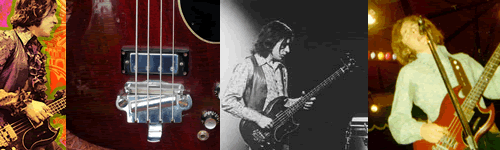
15. Jack Bruce Gibson EB-3 - The classic Gibson EB-3 was made famous during Cream’s live
tours during the 60’s, one of the most famous Vintage Gibson Bass Guitars. By cranking
up the volume on his Gibson EB-3, Bruce unwittingly produced the heavy
distorted sound he made popular. Later, by installing a diode into his EB-3’s
wiring, Bruce was able to produce the same effect without overdriving his amps.

16. Tom Peterson of Cheap Trick-12 String Hamer Bass - Tom Peterson of Cheap Trick played the first-ever 12 string bass guitar. It was created by The Hamer Guitar Company in the late 70’s, by combining a 4-string bass with a 12-string guitar. (Think 4 bass strings with 2/3s of a 12-string guitar, 4 + 8). It’s really just an extension of the 8-string bass invented in the ‘60’s by the Hagstrom Guitar Company. The 12-String Bass has grown in popularity and is probably best known in the intro. Of the Pearl Jam Classic, Jeremy, when played by Jeff Ament (honorable mention).

17. Mike Gordon of PHISH's Modulus 5 String Bass - Ten years ago this would have been the Paul Languedoc Dragon Bass, but Mike has been steady with the Modulus for some time now. One of the world's underrated bass players, Gordon brings 100% of the funk every show.

18. Cliff Burton’s Rickenbacker 4001 Bass – Cliff Burton, Metallica Bass Player for its glory days of its first 3 albums was a unique thrash metal bass player who uniquely played lead bass lines with signature fuzz that declared a dominant existence on some really classic tunes.


20. Roger Glover’s Rickenbacker 4001 Bass – Although not famous for playing a unique branded instrument, I feel Glover deserves to be on this list. I have seen him play Fenders, Ovations, Music Mans and others, but his coolest instruments by far were the 4001’s he played w/ Purple in the 1970s. Always has been a favorite, steady player, who has had the responsibility to have played on some historical rock classics.
Subscribe to:
Posts (Atom)